

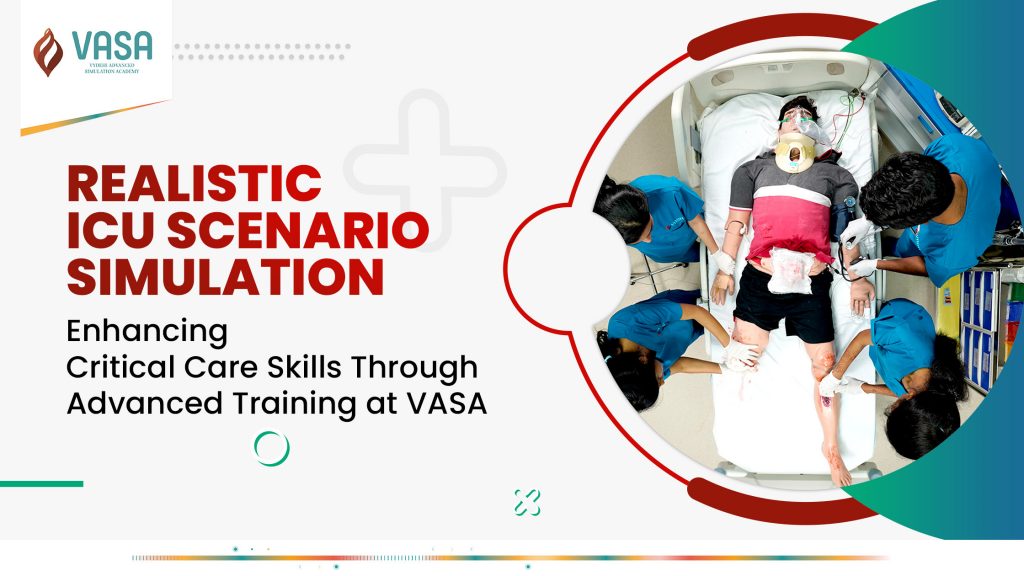
In modern healthcare, Intensive Care Units (ICUs) demand rapid decision-making, clinical precision, and coordinated teamwork. To meet these expectations, realistic ICU scenario simulation has become a vital part of training for doctors, nurses, and emergency teams. At Vydehi Advanced Simulation Academy (VASA), immersive simulation-based education empowers healthcare professionals to practice, learn, and refine their skills in a safe and controlled environment.
Today, simulation is not just a teaching tool—it is a bridge between theoretical knowledge and lifesaving clinical action. VASA’s advanced simulation labs recreate ICU simulation, emergency medical simulation, and critical care scenarios to equip learners with hands-on competence in critical patient care.
Why Realistic ICU Simulation Matters?
The ICU is often unpredictable. Patients deteriorate rapidly, emergencies strike without warning, and clinicians must act instantly. Realistic simulation helps trainees:
- Experience high-risk situations without harming real patients
- Practice critical care management and decision-making under pressure
- Strengthen communication and team coordination
- Build confidence in handling emergencies
Through ICU care management, ICU emergency management, and critical patient management scenarios, VASA helps learners understand what to expect in real-world critical care environments.
What Happens During an ICU Scenario Simulation?
A typical ICU simulation at VASA includes:
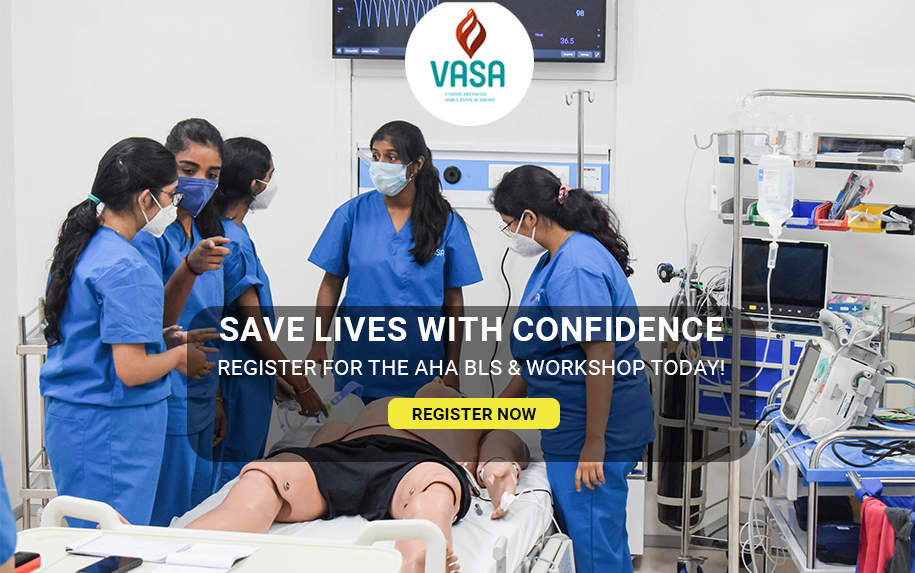
1. High-Fidelity Manikins & Realistic ICU Setup
Learners train in environments that mirror actual ICUs—ventilators, infusion pumps, monitors, defibrillators, and critical care equipment.
2. Real-Time Clinical Situations
Examples of ICU simulation scenarios include:
- Septic shock management
- Acute respiratory failure requiring intubation
- Postoperative ICU complications
- Cardiac arrest and resuscitation
- Multi-system organ failure
- Trauma patient stabilization
These critical care cases help learners sharpen clinical judgment and prioritize care.
3. Interdisciplinary Teamwork
Doctors, nurses, and technicians train together to understand shared roles. This helps improve critical care nursing management, handovers, and collaborative decision-making.
4. Debriefing & Reflective Learning
Every session ends with an in-depth ICU healthcare simulation scenarios & debriefing discussion. Facilitators guide learners through:
- What went well
- What could improve
- Clinical reasoning
- Communication patterns
- Safety practices
This reflective element builds long-term competence.
Types of Simulation Scenarios Used at VASA
VASA uses a structured approach to simulation-based training, ensuring learners cover all domains of ICU and emergency medicine.
1. Medical Simulation Scenarios
Focus on acute physiological deterioration such as:
- Severe hypoxia
- Hypertensive crisis
- Seizure emergencies
- Shock management
These cases are ideal for critical care medicine and anesthesia simulation scenarios.
2. Emergency Situation Simulation
Trainees handle unpredictable, time-sensitive events like:
- Massive bleeding
- Arrhythmias
- Stroke
- Cardiac emergencies
These exercises are essential for professionals in emergency medicine simulation.
3. Disaster Simulation Exercises
Large-scale, multi-casualty events:
- Natural disasters
- Industrial accidents
- Fire incidents
- Mass casualty emergency triage
These disaster simulation exercises help build preparedness and coordination.
4. Nursing Simulation Scenarios
Designed to build practical and leadership skills for ICU nurses:
- Ventilator troubleshooting
- Medication safety
- Pressure injury prevention
- Patient monitoring & handover
- Infection control in ICU
These scenarios support learners pursuing critical care nursing courses or ICU management training.
5. Critical Care Scenario-Based Assessment
Using high-pressure cases, learners demonstrate:
- Rapid assessment skills
- Airway, breathing, circulation (ABC) priorities
- Safe medication administration
- Evidence-based protocols
- Ethical decision-making
This strengthens the overall foundation of critical care medicine and nursing simulation scenarios.
How Simulation Supports Continuous ICU Education?
Simulation is transforming medical education by creating experiential learning opportunities. At VASA:
- Critical care courses and critical care nursing courses include hands-on simulation modules
- Learners engage in both basic and advanced ICU management
- Scenario-based teaching helps reduce medical errors
- Simulation-based education improves patient safety and clinical outcomes
The goal is simple: to prepare healthcare professionals for the complexities of real ICU practice.
Benefits of Realistic ICU Scenario Simulation at VASA
✅ Safe environment for learning
Trainees practice high-risk procedures without fear of harming patients.
✅ Builds confidence
Repeated exposure to emergencies helps professionals act decisively.
✅ Improves communication & teamwork
Team-based simulations replicate real ICU workflows.
✅ Enhances critical thinking
Learners analyze, plan, and respond to rapidly changing patient conditions.
✅ Strengthens clinical skills
From airway management to ICU monitoring, the training is comprehensive.
✅ Boosts readiness for real emergencies
Trainees are better prepared for sudden clinical deterioration and crisis situations.
Realistic ICU simulation is a powerful educational tool that builds competence, confidence, and clinical precision. At VASA, every scenario—from routine ICU monitoring to complex emergency situations—prepares healthcare learners to deliver high-quality, safe, and patient-centered care.
By integrating simulation in emergency medicine, ICU care, and critical care nursing, VASA continues to lead the way in advanced medical simulation education.
Frequently Asked Questions (F/AQs)
1. What is ICU simulation?
ICU simulation is a training method using realistic scenarios and high-fidelity manikins to teach critical care skills.
2. Who can participate in ICU scenario simulation?
Doctors, nurses, interns, paramedics, and students pursuing critical care courses or nursing simulation training.
3. What are common ICU simulation scenarios?
Respiratory failure, septic shock, cardiac emergencies, postoperative complications, and trauma cases.
4. How does simulation help improve patient safety?
Learners practice procedures, communication, and crisis management without risk, reducing real-life errors.
5. Are ICU simulations useful for nurses?
Yes. Critical care nursing scenarios help nurses strengthen monitoring, medication administration, and ICU management skills.