

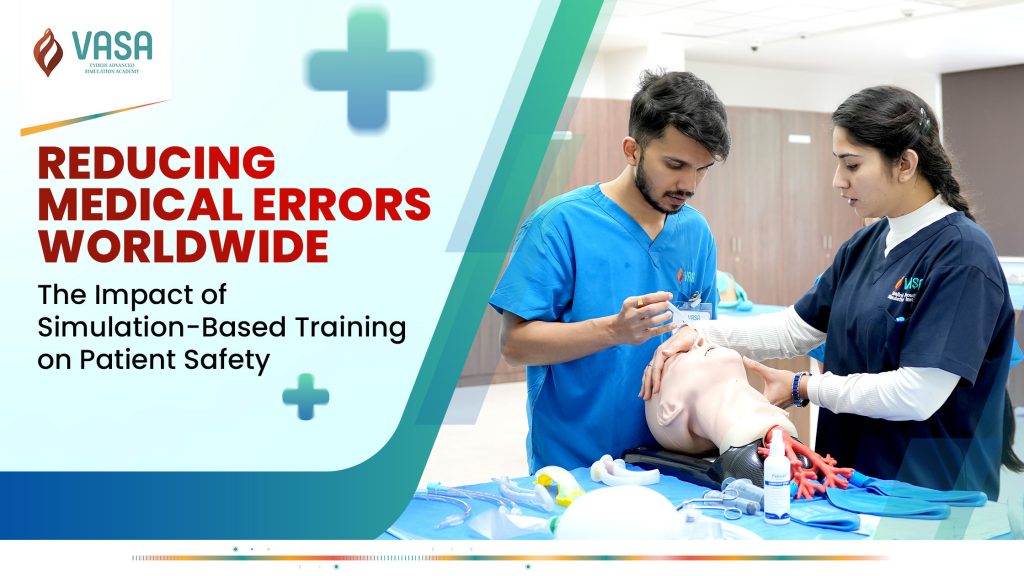
Medical errors remain one of the most critical global challenges in healthcare. They contribute to preventable harm, delayed interventions, and increased costs in hospitals worldwide. To combat this growing concern, healthcare education is rapidly evolving — with simulation-based training in healthcare emerging as one of the most effective tools to improve safety and clinical accuracy.
At Vydehi Advanced Simulation Academy (VASA), simulation is not just a teaching method; it is an advanced, research-backed solution designed to enhance skill development, strengthen decision-making, and reduce the risk of clinical mistakes. Through high-fidelity simulators, immersive technology, and structured training, healthcare professionals learn to manage real-life medical situations confidently and safely.
Understanding the Global Problem of Medical Errors
Medical errors occur due to multiple factors such as:
- Inexperience in handling complex cases
- High-pressure environments
- Communication gaps
- Limited exposure to rare emergencies
- Insufficient hands-on practice
This is why medical simulation training is becoming essential worldwide — offering safe, controlled environments where learners can practice, repeat, and perfect skills without risking patient harm.
What Is Healthcare Simulation?
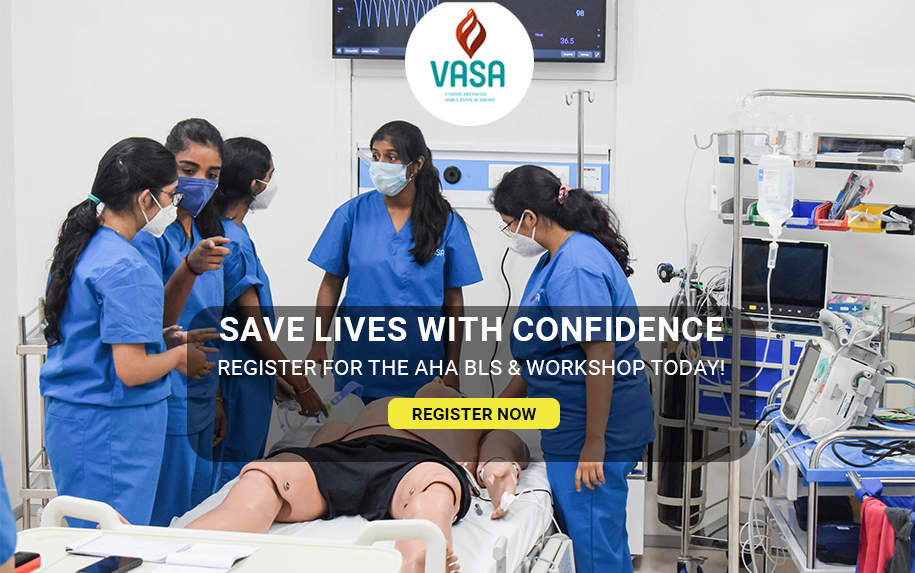
Healthcare simulation uses advanced manikins, digital platforms, standardized patients, and virtual reality medical simulation tools to recreate realistic medical scenarios. These controlled environments allow learners to practice procedures, emergency responses, and patient communication just as they would in real clinical settings.
This form of simulation-based education in healthcare bridges the gap between theory and practice by offering experiential, hands-on learning that mirrors real-life medical challenges.
How Simulation-Based Training Reduces Medical Errors
1. Safe Learning Without Risk to Patients
Simulation provides a safe zone where learners can attempt procedures, make mistakes, understand consequences, and refine techniques — all without risking patient safety.
2. Strengthening Clinical Judgment
High-fidelity simulators expose learners to complex cases such as cardiac arrest, trauma, airway obstruction, and critical care emergencies. This enhances real-time decision-making and reduces hesitation during actual patient care.
3. Enhancing Technical Accuracy
Skills such as intubation, IV insertion, CPR, catheterization, and wound management require precision. Simulation allows repetitive practice, leading to greater accuracy and fewer hospital-based errors.
4. Improving Teamwork and Communication
A major cause of errors is miscommunication. Simulation training encourages interprofessional collaboration, teaching doctors, nurses, and technicians to coordinate effectively.
5. Exposure to Rare Scenarios
In real-life clinical training, learners may rarely encounter high-risk or critical cases. Simulation ensures exposure to a wide variety of scenarios — improving preparedness and reducing errors.
The Power of Virtual Reality Healthcare Simulation
Virtual reality healthcare simulation is transforming medical learning through immersive, 3D clinical environments where learners can practice:
- Surgeries
- Emergency responses
- Procedural tasks
- High-risk patient management
VR’s benefits include unlimited practice, remote learning capability, and improved retention — making it an essential component of modern simulation training in healthcare.
Simulation-Based Training in Nursing
Nurses often perform continuous patient monitoring, emergency management, medication administration, and critical decision-making. Thus, simulation-based training in nursing is crucial for strengthening safe nursing practices.
Simulation helps nursing students improve:
- Clinical assessment
- Communication
- Medication safety
- Patient monitoring
- Emergency care response
This directly reduces the risk of nursing-related clinical errors.
Effectiveness of Simulation-Based Learning
Research consistently shows the effectiveness of simulation-based learning in improving knowledge, clinical judgment, and patient outcomes. It supports:
- Better skill retention
- Improved teamwork
- Enhanced crisis resource management
- Stronger confidence during real-life procedures
- Fewer preventable medical mistakes
The effectiveness of simulation-based learning in nursing education and medical education has been widely documented — establishing simulation as a global standard.
Types of Simulation in Medical Education
There are various types of simulation in medical education, including:
- Low-fidelity simulators (task trainers)
- Medium-fidelity simulators
- High-fidelity simulators (responsive manikins)
- Virtual reality medical simulation systems
- Standardized patients (actors for communication training)
Each type supports different levels of learning based on curriculum needs and learner expertise.
The Impact of Medical Simulations on Reducing Medical Errors
Medical simulations enhance:
- Clinical skills
- Analytical thinking
- Emergency readiness
- Diagnostic accuracy
- Patient handling
- Communication
This leads to safer care and fewer mistakes. Around the world, healthcare systems rely on simulation to standardize training and build a culture of patient safety.
Benefits of Simulation Training in Healthcare
Key benefits include:
- Safer learning environment
- Enhanced skill mastery
- Immediate feedback
- Increased clinical confidence
- Improved patient outcomes
- Global reduction in medical errors
This is why simulation is widely recognized as one of the most effective tools for improving patient safety and training healthcare professionals.
Why VASA Leads in Simulation Education
VASA provides:
- Advanced manikins and technologies
- VR-integrated medical simulation
- Skill-specific simulation modules
- High-fidelity critical care scenarios
- Experienced faculty guidance
- Structured assessments and debriefing
With its cutting-edge environment, VASA ensures learners are fully prepared for real clinical settings with reduced chances of medical errors.
Frequently Asked Questions
1. What kind of patients are in ICU during simulation scenarios?
Simulation labs replicate ICU environments to train learners on critical care patients with conditions like respiratory failure, sepsis, cardiac issues, or neurological emergencies.
2. What are the 4 types of ICU?
Medical, surgical, neonatal, and cardiac ICUs — all of which can be simulated for training purposes.
3. What to expect in a hospital intensive care unit (ICU) during simulation?
Learners experience realistic patient monitoring, emergency responses, communication practice, and hands-on procedures.
4. Is simulation-based learning effective for nursing?
Yes, it significantly improves nursing skills, confidence, and patient safety outcomes.
5. What is the impact of simulation training in medical education?
It reduces errors, enhances skill development, and prepares learners for real clinical challenges.
Learn About VASA Workshop
Enhance your clinical skills with hands-on, simulation-based training designed for real-world medical challenges. Discover course modules, learning outcomes, and training benefits.
Explore VASA WorkshopLearn About AHA Workshop
Get certified with internationally recognized AHA training programs. Strengthen your emergency response skills through high-fidelity simulations guided by expert instructors.
Explore AHA Courses